

If you don’t fully understand what KPI metrics can be used to measure and evaluate the performance of an SEO agency or a private contractor (freelancer), then this article is for you. We will tell you about the most common pitfalls, client expectations and reality, talk about the top 5 most important metrics, and show you an example of an appendix to a contract for SEO promotion.
In all likelihood, the readers of this article will be owners, CEOs or sales executives, or Internet marketers. Based on our practice and statistics for 15 years, they can be divided into two categories:
KPI (Key Performance Indicators) – is an outcome indicator that can be measured and expressed in a numerical format. It helps to evaluate the success of the work in a particular area.
KPI indicators should be defined before the contract is concluded. The goals, which in the end should be achievable indicators and fixed in the contract between the client and the SEO company.
The 4 main benefits of using KPIs in SEO promotion:
Unfortunately, many companies set themselves the primary goal at the start of work, which is to sign a contract and get an advance payment for the work as soon as possible. While the sales department describes mind-boggling growth and “guarantees” to get into the top of the niche for the main “fat” key customer queries.
So, the contract is signed, the advance payment is sent (in some cases even several months in advance). It would seem to be “work-in-progress”, but there are no visible results after several months. And the SEO-company claims that SEO-promotion is an “investment in the long run”.
The client, in turn, having invested money, wants to see the “result” he was coolly sold on the sales pitch, and there is none. At this point, the client opens the signed contract where they find information that the company will be doing SEO promotion of the site for the main keywords, there are no guarantees for SEO promotion, nor are there any basic metrics for promotion. It’s a boilerplate “fish-out-of-water contract.”
Above I described a very standard situation in our market, when at the conclusion of the contract, the client trusts the salesman, reads the standard contract and believes that these very same seoshniki will create a certain ritual, in which his site will shoot to the TOP. In practice, such stories end in disappointment on the part of clients.
How to avoid such mistakes?
Organic traffic growth is the most important key metric for any website. This metric, in fact, reflects the result of the SEO company’s work. Before promoting a website, an SEO promotion strategy is prepared in which the company makes a forecast of organic traffic growth.
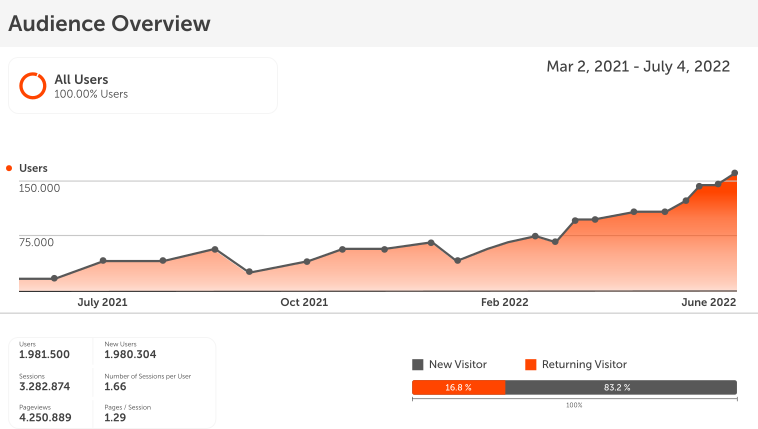
Organic traffic growth can be checked using Google Analytics and also in Google Search Console / Performance for a specific period.
More about the preparatory work in the article – Stages of SEO-promotion. For example, in our company in the first months of work there is a significant overwork of specialists by hours, on average it is x2-x3 of the normal time, in the following months we smoothly distribute time and work in normal mode. This redistribution of internal resources has no effect on the cost of promotion and serves to achieve results already in the first months.
CR (Converction Rate) – the achievement of a certain goal by visitors to the site. For different types of sites the goals can be different, for example:
The calculation is based on the formula:
CR = A/B*100%, where:
Example:
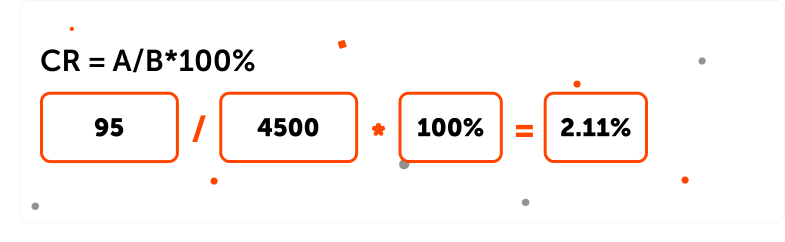
Can be tracked for specific promoted keywords that are most relevant to your business.
In case you are guaranteed 100% TOP for your desired keywords, refuse to work with this company. No SEO company can guarantee 100% of getting to the TOP, and those who guarantee it are incompetent in most cases.
Case in point.
We had a foreign client who flew to Moldova to search for an outsourced SEO-company to promote a website on airline tickets under USA, with a budget of 200K euros and a desire for a guaranteed top ranking for the query – airline tickets. Of course, we refused and justified the impossibility of not only any guarantees, but also the achievement of his goals, even with his budget. The client, full of determination, went further to measure the temperature of the market. How it ended, we do not know, but with a high probability the story from the first paragraph with the “contract fish”.
Positions are important and need to be tracked to observe the positive or negative impact of improvements made to the site (linking, content, etc.) that affect a particular query cluster under a page.
Here everything is relatively simple. There is a Semantic keyword set, which contains a promoted list of keywords. From the number of tracked keywords, we track which positions (pages) the queries are on:
Tracked keywords – 468
It’s worth noting that keyword positions are very dynamic, and it’s worth evaluating the results over a period of at least 7 days.
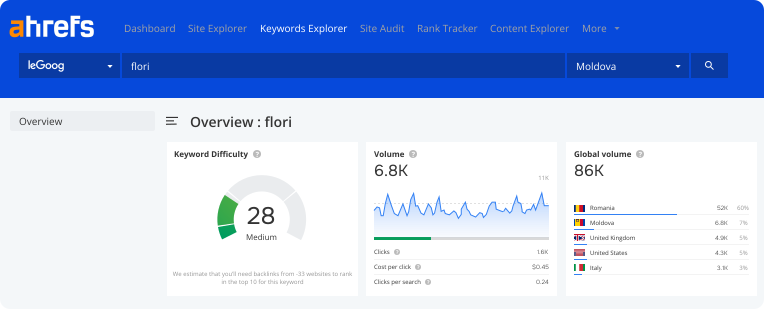
The basic trick in SEO is that over time, the cost per click of a visitor will decrease.
CPC (cost per click) – price per click.
The formula used for the calculation is:
Example:
Calculation by formula:
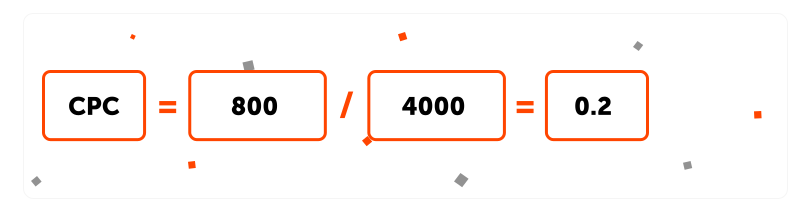
The cost of 1 click from the organic issue will be equal to – 0.2 cents
With a successful SEO strategy, the CPC should decrease from month to month, as the number of visitors to the site will inevitably increase as the visibility of the site in search engines increases, positions on relevant keywords improve and more niche semantics are covered.
The average length of time a user stays on a site is a relatively controversial metric. You can track the time visitors spend on new pages created during promotion. If the metrics are low, it is worth reviewing the content on the new pages, perhaps it does not reveal the problem or need of the user. But it is also likely that there was such a successful optimization of the page that users very quickly performed the target action.
Bounce rate is a rather selective metric. A bounce is a user session where the user has viewed only one page of the site and has not made any other requests to the server. This metric is not important at all for lendings, informational blogs, news sites, video hosting sites and similar sites where a targeted action is not expected or a user is unlikely to go deep into the site. This metric can be considered for online stores, service sites and others, where a high bounce rate can mean low relevance of the page to the user’s search query. Much more important is a closely related indicator, which search engines do not reflect in their analytics – the refusal with a return to the search results and the transition to another search result, which is a signal of low relevance of the original resource.
These metrics will be irrelevant from May 2023, as they are being excluded from Google Analytics 4, the migration to which will be mandatory for all Google Universal Analytics users.